Theme Labs
Konduit is the only supported theme. It's the experience every organization gets for free, it's pinned in the navigation, and it's the one we test, version, and stand behind. If you're running real workloads through a theme, run them through Konduit.
Everything below is a lab: an experiment built on the theme contract because themes are fun — and fun is a feature. A theme that makes someone smile is often the thing that gets a team to try the platform at all. Labs are where we push on what the theme contract can express, find its sharp edges, and feed what we learn back into the spec.
Lab themes ship as-is. They may break, change, or disappear without notice, and they don't get support SLAs, migration paths, or security review beyond registration checks. The platform resources they render — your zones, apps, and character — are always safe: themes are views, not silos, so nothing you do in a lab theme is lost when you switch back to Konduit.
Current experiments
Metropolis 🏙️
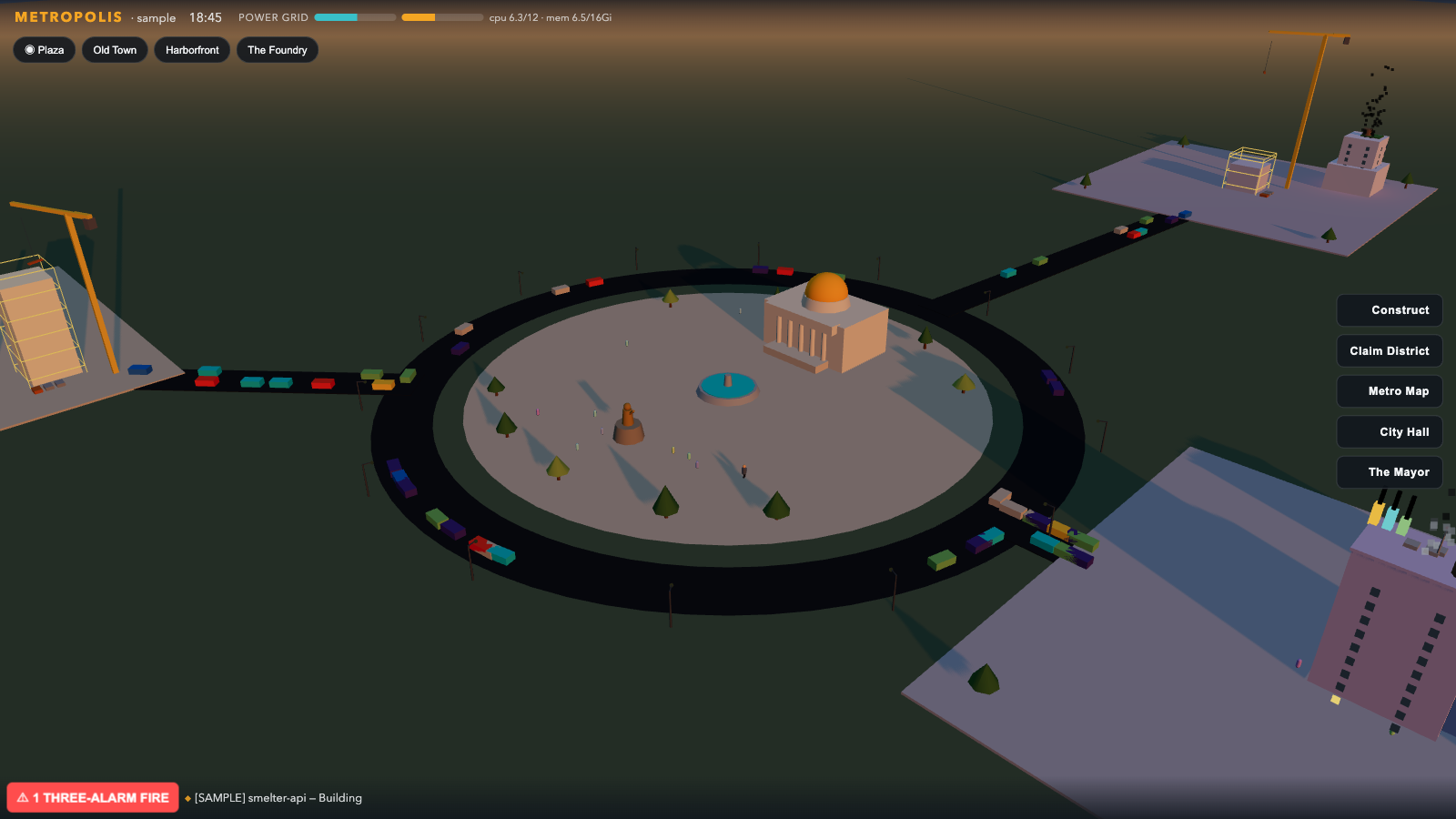
You are the Mayor. Your org is a living city. A full game-profile theme that renders the launched org as a real-time 3D city: districts are zones, buildings are apps grown procedurally from their own names, and the sun tracks your actual local time — golden hour at every real dusk, lit windows and streetlamps after dark. The city tells the truth at a glance: builds raise working cranes floor by floor, a Failed app is a three-alarm fire with an incidents chip that finds it in one click, and every open-for-business building carries rooftop utility gauges — gold for CPU, teal for memory, green for network — drawn live from real metrics, with window-light density and rooftop smog to match.
The full write surface is real. Claim districts, construct buildings from your registered repositories with a Power Grid fit forecast, scale replicas into wings and towers, reroute supply lines (branches), attach basement warehouses (volumes) and street addresses (custom domains), and demolish with a typed confirmation. Demolished buildings leave pocket parks: the Metro Map only accretes, keeping every district and building the org has ever raised. The Mayor walks the plaza in whatever cosmetics you've unlocked, and one district chip flies the camera to any zone.
Metropolis is also our working example of driving a real-time renderer from the theme contract: a one-way data flow (bridge → city state → reconcilers) keeps the three.js scene stable as zones and apps come and go — nothing ever moves once built — and a mock-parent harness in the repository exercises the full postMessage contract offline.
- Source (public): konstructio/theme-metropolis
- Profile:
game· themes: zones as districts, apps as buildings, quota as the Power Grid
Beach Club 🏖️
The shore report for your cluster. An informational theme that pairs theme contract zones and apps with deep Kubernetes observability from groundcover — eBPF golden signals, cluster health, events, and logs, zero instrumentation. The hero's tide is drawn by real CPU load, and conditions read clean / choppy / blown out from the state of your boards.
Beach Club is also our working example of separating data planes in a theme: what the theme contract declares (theme contract · spec), what observability measures inside your zones (groundcover · measured), and control-plane telemetry — each labeled, so nobody mistakes a spec value for a measurement.
- Source (public): konstructio/theme-beach-club
- Profile:
informational· themes: zones as beaches, apps as boards
Reference themes
Not labs — these are the documented starting points for building your own:
- Starter — the flagship read-only reference: every read the theme contract offers on one dashboard; copy it to begin
- Ship It! — the full
gameprofile, and the pattern for wiring an existing frontend to the theme contract
Want to build one?
Labs exist to be copied. Start with Creating a theme, keep static/theme.js byte-for-byte, and remember the two rules that make experiments safe: a theme never sees a credential, and a theme must not obscure the truth. Beyond that — planets, race tracks, beaches, whatever gets your team excited to ship.